

AI consulting for small businesses is a professional service where a consultant evaluates how your business currently operates, identifies where artificial intelligence can reduce manual work and improve efficiency, and then builds and deploys those AI systems for you. The right AI consultant doesn't just recommend tools. They understand your business well enough to know which tools matter, which ones you don't need, and how everything connects to the way you actually work.
Most small business owners have experimented with AI on their own. They've used ChatGPT to draft emails or brainstorm ideas. But there's a wide gap between casually using a chatbot and having AI integrated into your operations, marketing, client experience, and backend systems. An AI consultant bridges that gap.
What an AI Consultant Actually Does
An AI consultant does three things that are hard to do on your own: they see the full picture, they know what's possible, and they build the systems that connect everything.
When you're inside your own business, you can see the bottlenecks but you can't always see the solutions. You know your onboarding takes too long, your follow-up falls through the cracks, and your content creation is manual and inconsistent.
What you might not know is that all of those problems can be connected through AI into a single system that runs with minimal oversight.
Here's what that work typically includes:
- Auditing your current workflows, tools, and operations to find where AI would make the biggest impact
- Mapping which systems should talk to each other and what's currently disconnected
- Recommending the right AI tools for your specific business (not the trendiest ones)
- Building and deploying automations, AI agents, and integrated workflows
- Training your team to actually use what gets built
- Providing ongoing support as the systems evolve
If you want a deeper look at what AI implementation covers across all five areas of a business, I wrote a full guide on AI for small business that walks through each one.
The key difference between an AI consultant and a tech vendor is the starting point. A vendor leads with their product. A consultant leads with your business.
If someone starts the conversation with a demo of their software, that's a sales call. If they start by asking about your operations, bottlenecks, and goals, that's consulting.
If someone starts the conversation with a demo of their software, that's a sales call. If they start by asking about your operations, bottlenecks, and goals, that's consulting.
Why 95% of AI Implementations Fail to Deliver Real ROI
This is the stat that changes the conversation.
That number doesn't mean AI doesn't work. It means that 95% of the time, businesses are implementing AI without the business strategy to make it productive. They're buying tools without mapping workflows and automating processes that shouldn't exist in the first place. Then they layer AI on top of broken systems and wonder why the results don't show up in revenue.
When businesses hire outside help, the success rate more than doubles. And that makes sense. An AI consultant has the outside perspective to see what you can't see from inside, plus the technical knowledge to build what you wouldn't know how to build on your own.
The businesses that land in the 5% that DO see meaningful ROI are the ones that start with a clear business problem, not a shiny AI tool. They audit first. They prioritize based on impact. And they bring in someone who understands both the business side and the technical side.
That combination is rarer than you'd think.
What the Engagement Looks Like
If you've never worked with an AI consultant before, here's what the process typically looks like. Every consultant runs it slightly differently, but the structure follows the same general path.
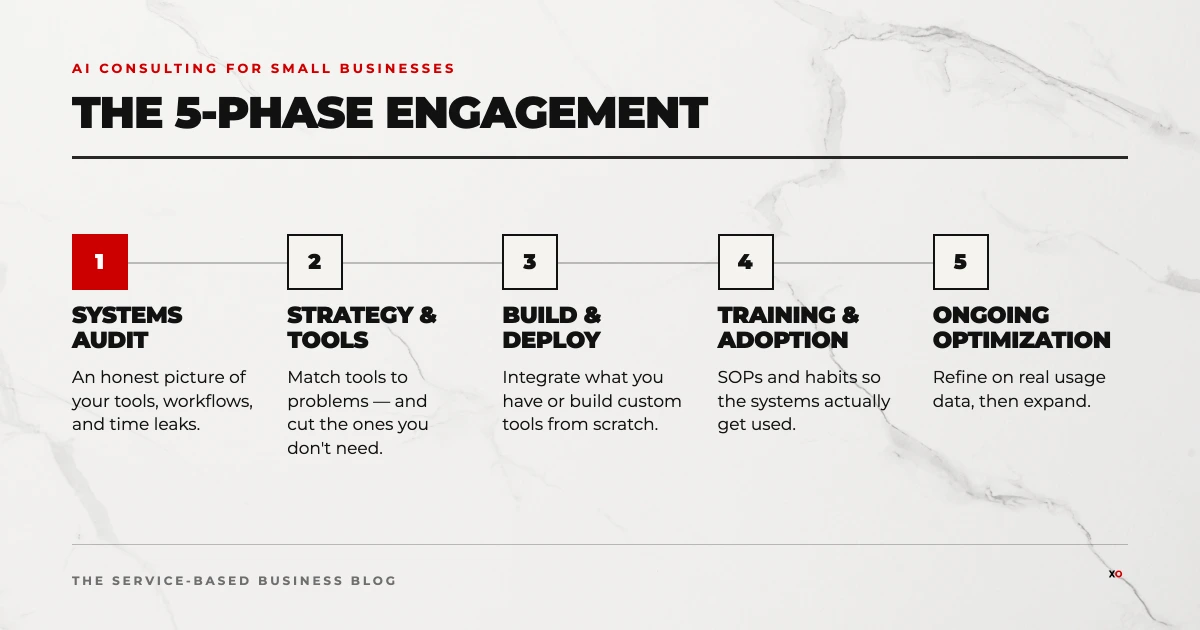
Phase 1: Systems Audit
Before anything gets built, the consultant needs to understand what you're working with right now. What tools are you using? How do your workflows actually run day to day? Where are the time leaks? Where are your systems held together by someone's memory instead of documentation?
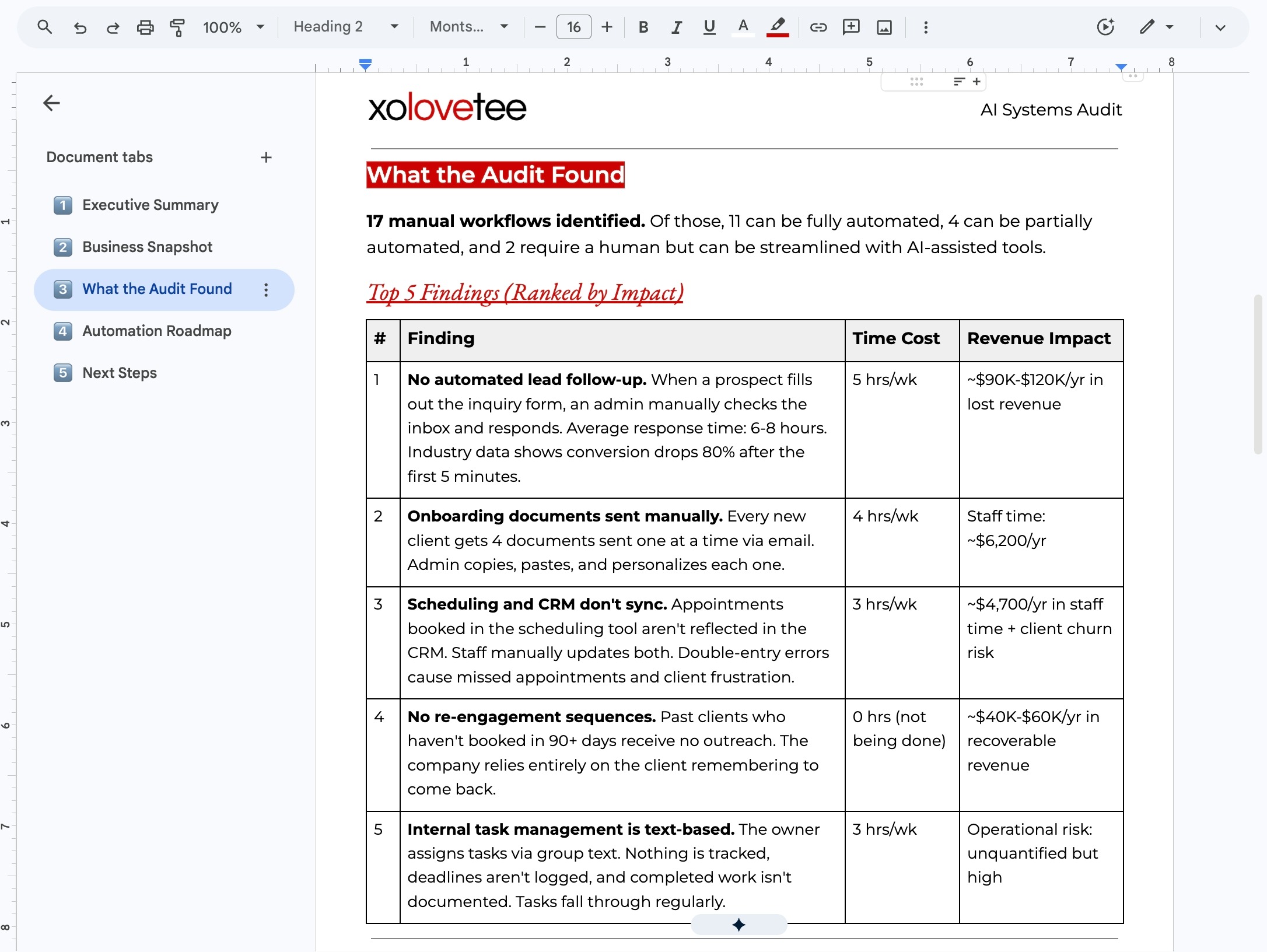
This phase is about getting a clear, honest picture of your business operations. It's also where the consultant earns their fee, because the insights from the audit determine everything that comes next.
Phase 2: Strategy and Tool Selection
Based on what the audit reveals, the consultant matches tools to problems. Which areas get AI first? What's the priority? What tools actually fit your business without creating more complexity? And just as importantly, which tools do you already have that you don't even need? I've done audits where the AI platform the client was already using had built-in connectors that did the job of a separate tool they were paying for monthly. Part of the consultant's job is trimming the fat, not just adding more software.
This is where a good consultant saves you thousands of dollars. Without a strategy, you end up with subscriptions you don't use and tools that don't connect. With a strategy, every tool has a purpose and a place in the system.
Phase 3: Build and Deploy
This is where the work happens, and you have two paths depending on what your business needs.
You can integrate existing tools into your workflows, connecting the software you already use through automation platforms or built-in AI features. Or, if your current tools can't work together the way you need them to, an AI consultant can build custom internal tools from scratch using AI.
I bring this up because a lot of the business owners I work with had no idea that was even possible. When they hear "AI consulting," they think someone is going to recommend a list of subscriptions. The fact that AI can actually build the tool you need, designed around your exact workflows, changes the conversation completely.
Phase 4: Training and Adoption
The systems don't matter if your team doesn't use them. This phase is about getting everyone comfortable with the new workflows, building the daily habits, and creating SOPs around the tools so they actually stick.
That stat tells you why training is its own phase. If your team is using AI without a strategy for how to prompt, what to use it for, and how it fits into their daily workflow, you're getting inconsistent results at best and no results at worst.
Phase 5: Ongoing Optimization
AI systems get better over time, but only if someone is paying attention. This phase is about refining based on real usage data, adjusting workflows that aren't performing, and expanding to new areas once the foundation is solid.
The timeline varies. For a solo service provider with straightforward workflows, this whole process can happen in a few weeks. For a business with a team, multiple disconnected tools, and no documentation, it takes longer. But the phases are the same regardless.
How Much Does AI Consulting for Small Businesses Cost?
The range is wide because AI consulting can mean anything from a one-time assessment to a full systems overhaul with custom-built tools. Here's what the market looks like right now so you can budget accordingly.
| Engagement Type | Typical Cost Range |
|---|---|
| AI readiness assessment | $2,000 – $5,000 |
| Systems audit + strategy | $5,000 – $15,000 |
| Full implementation (build + deploy) | $10,000 – $50,000 |
| Monthly retainer (ongoing optimization) | $1,500 – $8,000/month |
| Hourly advisory | $150 – $300/hour |
The cost depends on how complex your operations are, how many tools and workflows need to be connected, whether you need custom tools built, and how much training your team needs.
What that 3.7x looks like in practice depends entirely on what area of your business the AI consulting focuses on.
If you're focused on operations, the ROI shows up as time saved. Manual tasks that took hours get automated, your team gets those hours back, and you reduce the need to hire for admin roles as you grow.
If you're focused on sales and marketing, the ROI shows up as revenue. Better follow-up systems, automated lead nurturing, and faster content production mean more clients finding you and more deals closing. If you want to see how the full sales and marketing strategy for service-based businesses connects to AI, that guide covers the foundation.
If you're focused on scaling or preparing to franchise, the ROI shows up as infrastructure. You're building the documented, repeatable systems that let your business run the same way no matter who's operating it or where it's located.
Most businesses see positive ROI within 4 to 8 months, but the type of return depends on where the consultant focuses the implementation.
How to Choose the Right AI Consultant for Your Business
This is where I want you to pay close attention, because the AI consulting space has exploded and not everyone calling themselves an AI consultant has the experience to back it up.
1 — Look for business experience, not just technical skills.
The biggest mistake small businesses make is hiring someone who is brilliant with AI tools but has never run or consulted for a business. AI is the tool. Business strategy is the context.
If your consultant can build an automation but doesn't understand why your onboarding process matters to your revenue, the automation will be technically impressive and strategically useless.
The automation will be technically impressive and strategically useless.
2 — Ask if they've worked with businesses your size.
An AI consultant who builds solutions for enterprise companies with 500+ employees is solving a fundamentally different problem than one who works with service-based businesses with teams of 5 to 15.
The scale, the budget, the tools, and the approach are all different. Make sure their experience matches your reality.
3 — Find out if they implement or just advise.
Some AI consultants deliver a strategy document and wish you luck. Others audit, build, deploy, and train. If you need someone to actually get the systems up and running (and most small businesses do), make sure the consultant you hire does the implementation work and doesn't just hand you a plan.
4 — Check for the "strategy doc and disappear" red flag.
If you've hired consultants before who gave you a beautiful PDF and then vanished, you already know this feeling. Ask directly: what does post-deployment support look like? How long are you available after the systems go live? What happens when something breaks?
The right consultant puts you on the right side of that stat. The wrong one puts you in the 95% that spent money on AI and saw nothing meaningful come from it.
What Results Should You Expect?
AI consulting isn't an overnight fix. The timeline is real, and setting expectations correctly is part of what separates a good engagement from a frustrating one.
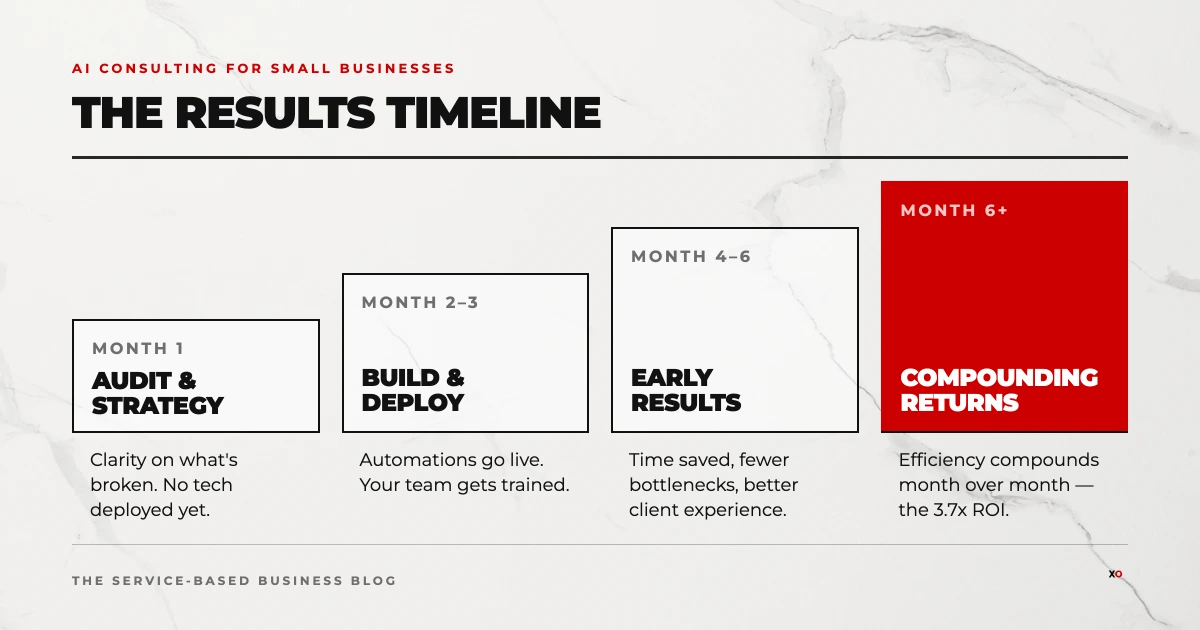
▶ Month 1: Audit and Strategy.
You're getting clarity on what exists, what's broken, and where AI will have the highest impact. No technology gets deployed during this phase. The consultant is learning your business and building the roadmap.
▶ Month 2–3: Build and Deploy.
The systems are being built and connected. You start seeing your workflows change as automations go live. Your team is getting trained on the new tools and processes.
▶ Month 4–6: Early Results.
The AI systems are running. You're saving time on tasks that used to be manual. Your follow-up is automated. Your content is being produced more efficiently. The leading indicators (more time, fewer bottlenecks, better client experience) start showing up before the revenue numbers move.
▶ Month 6+: Compounding Returns.
The systems mature. Your team is comfortable. The workflows get refined based on real usage data. This is where the 3.7x ROI shows up, because the efficiency gains compound month over month as the systems handle more of the repeatable work.
If you're only using one AI tool right now, imagine what happens when your entire operation is connected through AI. The jump from "I use ChatGPT sometimes" to "my business runs on integrated AI systems" is where the real ROI lives.
The Mistakes I See Small Businesses Make with AI Consulting
1 — Hiring a tech person when you need a business person.
AI implementation that doesn't start with business strategy produces technically impressive systems that don't move revenue. The consultant's job is to understand your business FIRST, then apply the technology. If they skip the business questions and go straight to building, the foundation is wrong.
2 — Expecting results without investing in training.
You can build the best AI system in the world, and if your team doesn't know how to use it, it becomes expensive shelf-ware. Training is where the adoption happens, and adoption is where the ROI lives.
3 — Trying to transform everything at once.
Start with one area. Get it working. Prove the ROI. Then expand. The businesses that try to overhaul every system simultaneously are the ones that stall out and abandon the project. Phased implementation works because it builds confidence and momentum.
4 — Choosing based on price alone.
A $2,000 AI assessment from someone with six months of experience is going to give you a very different outcome than one from a consultant with years of business and AI expertise. The cheapest option almost always costs more in the long run because you end up redoing the work.
5 — Going the DIY route when your business is past that stage.
If you're a solo operator with simple workflows, you can probably figure out AI on your own. But if you have a team, disconnected systems, and operations that depend on someone's memory, DIY is going to cost you months you don't have. Know which stage you're in and hire accordingly. And if your main challenge is marketing specifically, you might want to start with a marketing consultant before layering in AI.
Conclusion
AI consulting for small businesses is the bridge between "I use ChatGPT sometimes" and "my business runs on integrated AI systems." The technology is accessible. The tools are affordable. What's missing for most small businesses is the strategic guidance to implement it in a way that produces real, measurable ROI.
95% of AI implementations fail to deliver meaningful returns, and the reason is almost never the technology itself. It's the absence of business strategy behind the technology. An AI consultant who understands both your business and the tools available is how you land in the 5% that gets real results.
If you're a service-based business owner who knows AI could change how your business operates but you haven't been able to make it happen on your own, that's exactly the gap I work in every day.