

AI for small business is the practice of integrating artificial intelligence tools into your daily operations, marketing, client management, and service delivery to reduce manual work, speed up decisions, and scale without hiring proportionally.
Most small business owners are still using AI the same way they did when ChatGPT first launched: typing a question into a chatbot and copying the answer.
Real AI implementation looks completely different, and the gap between those two stages is where most of the money is being left on the table.
What AI for Small Business Actually Means in 2026
It means your business systems run with AI inside of them. Embedded in your workflows, running in the background, handling the repeatable work while you focus on delivering services to your clients.
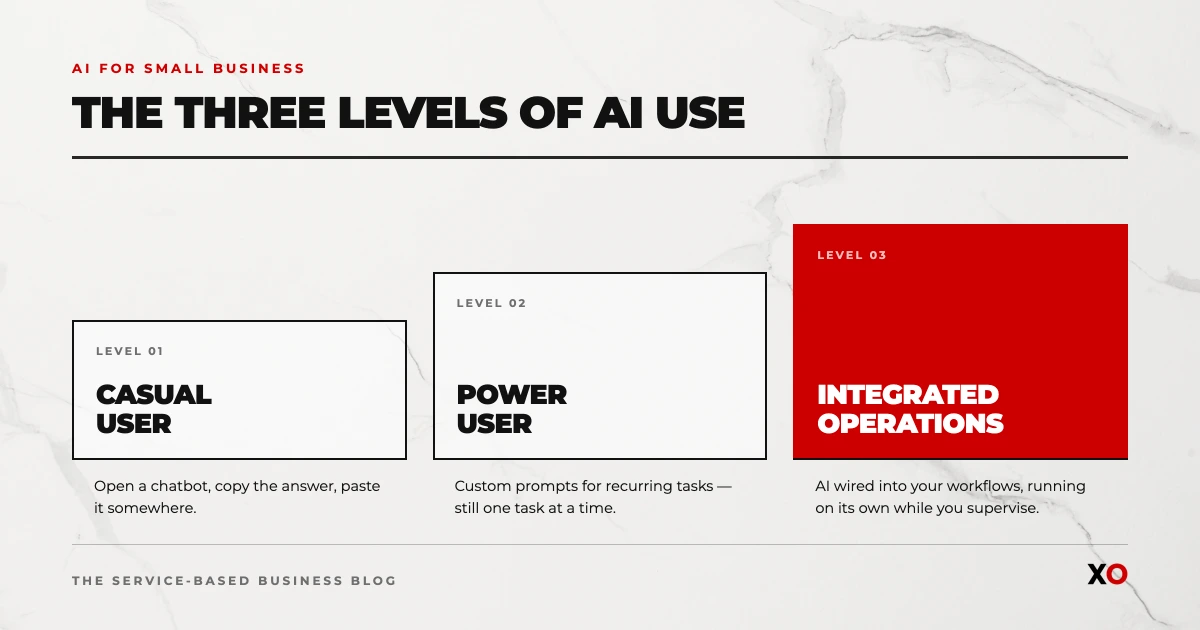
Now, most small business owners I talk to are what I call casual users. They open a chatbot, ask it to draft something, copy the output, and go paste it somewhere.
And if you're still using it that way, no judgment. But technically, that's using AI as a search engine. You're getting answers, but you're not building systems that actually run.
The next level is what I call power users, and this is what I want for you. These are the people who have figured out how to use AI for specific recurring tasks.
You're using it to write all your social media captions, or you've set up a prompt that generates client emails in your voice. That's a step up, but it's still manual. Still one task at a time.
Now, the third level is integrated operations, and this is where most small businesses with teams and employees want to get to.
This is where AI is wired into your actual business. The onboarding sequence triggers automatically. Content gets repurposed across five platforms without you touching it. The follow-up system runs on its own, and your SOPs get updated by the same AI that helped you write them.
You're not opening a chatbot every time you need something because the AI is already in the workflow. And when you peek in, you can see your agents talking to each other, watch the AI work, and step in from a supervisory role when you need to.
Honestly?? That's the goal for every business owner I work with.
That gap between 76% and 14% is the whole story right there. The vast majority of small businesses have tried AI, but barely any have implemented it at the systems level.
The Five Areas Where AI Changes a Small Business
When you hear "AI for small business," you probably think about content first. Writing captions, drafting emails, that kind of thing.
And yes, AI handles all of that. But content is ONE of five areas where AI actually changes how your business runs, and the majority of business owners never get past the first one.
| Area | What most people do now | What AI implementation looks like |
|---|---|---|
| Operations | SOPs live in your head or don’t exist | AI builds, maintains, and follows your SOPs |
| Marketing & Content | You open a chatbot and ask it to write something | One recording session becomes a month of content across 5 platforms |
| Sales & Acquisition | You follow up when you remember | AI runs your follow-up sequence automatically |
| Client Experience | Onboarding is a few emails you send manually | Automated intake, welcome sequences, and check-ins |
| Finance & Admin | You do invoicing and bookkeeping yourself | AI handles the backend so you can focus on delivery |
Let me walk you through each one.
Operations
This is the area that gets skipped the most, and it's the one that makes the biggest difference.
If your business runs on memory instead of documentation, AI can help you build the documentation AND automate the processes that come out of it.
I'm talking about your repeatable workflows. The steps you take every time you onboard a client, close a project, or hand something off to someone on your team.
If those steps aren't written down, they can't be automated. But if they ARE written down?? AI can run them for you.
Marketing and Content
This is where most small businesses start, and I get why. Content is the most obvious use case.
But the real play here is not "use AI to write me a caption." The real play is building a system where one piece of content turns into an entire month of marketing across every platform your clients are watching. That's where this gets exciting.
You see that imbalance? People figured out the content piece and stopped there. There's SO much more on the table.
Sales and Client Acquisition
Here's a stat that should bother you: 48% of service providers never follow up with a lead at all.
AI can run that follow-up for you. And I'm not talking about a generic drip sequence that sounds like a robot wrote it. I mean a real, personalized follow-up system that sends the right message at the right time based on where that lead is in your pipeline.
AI can also track your leads, score them based on behavior, and tell you which conversations are worth your time right now. The human connection still matters, obviously. AI just makes sure it happens with the right people.
Client Experience
Your onboarding, your communication during a project, your check-ins, your offboarding. All of that can be powered by AI without losing the personal touch.
I've built systems where the client gets a red carpet experience from the moment they sign, and most of it runs automatically behind the scenes.
Here's the key: AI handles the logistics so you can focus on the relationship. Your client doesn't know what's automated and what's personal. They just know the experience feels premium.
Your client doesn't know what's automated and what's personal. They just know the experience feels premium.
Finance and Admin
Invoicing, bookkeeping, expense tracking, reporting. This is the work that keeps your business running but has nothing to do with your actual expertise.
AI tools can handle most of it now, and they're accurate enough to trust with real money. If you're spending hours a week on admin work that doesn't require your brain, that's time AI should be handling.
How to Know If Your Business Is Ready for AI
Before you spend a dollar on any AI tool, you need to know what you're working with.
I call this the AI Readiness Audit, and it's the first thing I do with every consulting client before we touch any technology.
That confidence gap is real, and it exists because the starting point isn't obvious. An audit fixes that.
It shows you exactly where your business is, what's working, what's broken, and where AI would make the most impact.
The Self-Assessment
I want you to answer these questions honestly:
- Can you describe your client onboarding process in writing right now?
- How many tools does your team use that don't connect to each other?
- What tasks are you doing manually that happen the same way every time?
- If you left your business for two weeks, would it run without you?
- When was the last time you updated your SOPs? Do you even have them?
- How many hours a week do you spend on admin work that has nothing to do with serving clients?
If most of those answers made you uncomfortable, that's actually good news. It means there's a clear path forward and you know exactly where the gaps are.
If that sounds like you, you're not behind. You just need a plan. And that's what the rest of this guide gives you.
How to Choose the Right AI Tools for Your Business
Start with the problem.
I know that sounds obvious, but you would be amazed how many business owners come to me and say "I bought this AI tool and I'm not really using it." They bought it because someone on social media said it was amazing. They didn't buy it because it solved a specific problem in their business.
So here's how I think about it: map your workflows first, find the bottleneck, THEN go find the tool that fixes it. The tool is always last.
The Major Categories
| Category | What it does | Examples |
|---|---|---|
| AI Assistants | Chat-based tools for writing, research, strategy, brainstorming | Claude, ChatGPT, Gemini, Grok, Muse, OpenClaw |
| Automation Platforms | Connect your tools and automate workflows between them | Zapier, Make, n8n |
| Built-in AI Automation | Automation that lives inside the AI platform itself | Claude Code, GPT Actions |
| CRM with AI | Client management with AI-powered insights and follow-up | Depends on your business size and needs |
| Content & Marketing | Content creation, scheduling, repurposing, SEO | Varies by platform and workflow |
| Operations & PM | Project management, task tracking, SOP management | Varies by team size and complexity |
I use Claude as my primary AI assistant. It's what I run my entire business through, and it's what I teach in my AI workshops.
But the right tool for you depends on your specific workflows, your team, and the problems you're actually trying to solve. I can't emphasize this enough: the tool is never the starting point. The problem is.
What AI Implementation Actually Looks Like (Step by Step)
This is the part nobody talks about. Everyone tells you to "use AI in your business" and then hands you a list of tools and a good luck.
That's not implementation. That's a suggestion.
Real implementation has phases, and skipping them is how you end up with five subscriptions you never open.
The 5-Phase AI Deployment
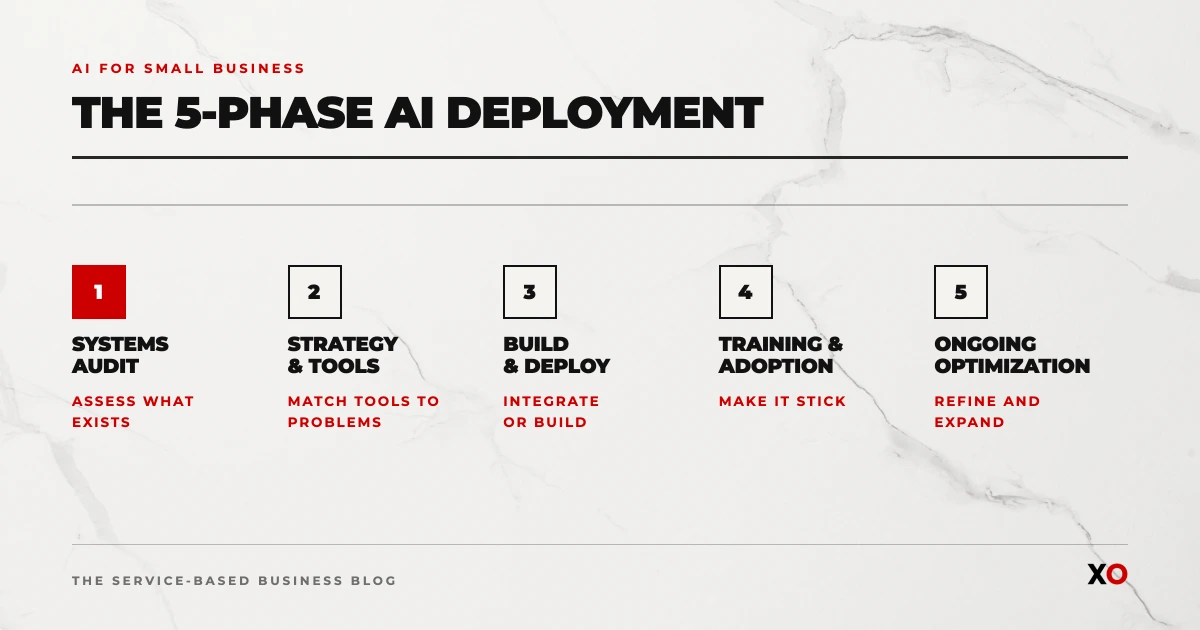
Phase 1: Systems Audit. You have to assess what exists first. What tools are you using? What workflows are manual? Where are the time leaks? Where are your systems held together by someone's memory instead of documentation? This is where the AI Readiness Audit comes in, and it's always the starting point.
Phase 2: Strategy and Tool Selection. Now you match tools to problems. Based on what the audit showed you, which areas get AI first? What's the priority? What tools actually fit your business without creating more complexity?
Phase 3: Build and Deploy. This is where the real work happens, and you have two paths.
You can integrate existing tools into your workflows. Or, if your current tools can't play nice together, you can use AI to build custom internal tools from scratch. That second path is something a lot of business owners don't even know is an option, and it's one of the most powerful things about where AI is right now.
Phase 4: Training and Adoption. The tools don't matter if your team doesn't use them. This phase is about getting everyone comfortable with the new systems, building the daily habits, and creating the SOPs around those systems so they actually stick.
You see why this phase matters? Most businesses skip it entirely and then wonder why nobody on the team is using the tools they just paid for.
Phase 5: Ongoing Optimization. AI systems get better over time, but only if someone is paying attention. This phase is about refining based on real usage data, adjusting workflows that aren't working, and expanding to new areas once the foundation is solid.
The timeline varies. For a solo service provider with simple systems, this can happen in a few weeks. For a team with multiple disconnected tools and no documentation, it takes longer. But the phases are the same regardless.
When to Do It Yourself vs. Hire an AI Consultant
Some businesses can absolutely handle this on their own. And some cannot. Here's how I'd think about it.
DIY makes sense when:
- You have a few tools and basic workflows
- You're comfortable with technology and you actually enjoy learning new systems
- You're the only one using the tools, so there's no team training needed
- Your operations are simple enough that you can map them out yourself
Hiring makes sense when:
- You have a team that relies on memory instead of documented systems
- Your tools don't talk to each other and you've been meaning to fix that for months
- You've been "figuring out AI" for a while and you're still in the same spot
- Your operations are held together by one person, and that person is probably you
- The revenue impact of getting this right is high enough that doing it wrong costs you real money
I built my AI consulting practice around that second group. The business owners who know something needs to change, who've maybe tried a few tools on their own, but who need someone to come in, audit the whole thing, build the systems, and train the team so it actually sticks.
That's what I do.
If that sounds like where you are, here's how we work together.
The Mistakes I See Small Businesses Make with AI
After working with hundreds of service-based business owners and running an AI deployment firm, I see the same patterns over and over again. And I want to save you from all of them.
Buying tools before understanding the problem. Someone sees a demo, gets excited, signs up for three new subscriptions, and then realizes none of them solve the actual bottleneck in their business. Map the problem first, every single time.
Using AI for content but ignoring operations. Content is visible. Operations are invisible. So people gravitate toward the thing they can see results from right away and ignore the backend work that would save them ten times more hours over the long run. I get it, but it's backwards.
Expecting AI to fix broken systems. If your operations are a mess, AI will automate that mess faster. AI amplifies whatever you give it. If what you give it is chaos, you get faster chaos. You have to clean the systems up first.
If you give AI chaos, you get faster chaos.
Not training the team. You deploy the tools and assume people will figure it out. They won't. They'll use it for a week and go right back to the old way of doing things. Training is its own phase for a reason.
Trying to implement everything at once. Pick one area. Get it working. Then expand. The businesses that try to overhaul everything at the same time are the ones that end up abandoning the whole project two months in.
Skipping the audit and going straight to buying subscriptions. You wouldn't renovate a house without walking through it first, right? Same principle here.
Conclusion
AI for small business is past the hype stage. The real question now is whether you're going to stay in chatbot mode or actually implement it into how your business runs.
76% of small businesses say they use AI. 14% have it embedded in their operations. That gap is where the competitive advantage lives right now, and the window is wide open for the businesses that move on it.
If you're a service-based business owner sitting in that gap, you have two options. Do the work yourself using the framework in this guide, or bring in someone who does this every day.
Either way, the audit is your starting point. Know what you have, know where the gaps are, and build from there.
The businesses that figure out implementation are the ones pulling ahead. The ones still typing into a chatbot and copying the answers are going to feel that gap widening every single month.