


A marketing consultant for small business is someone who comes into your business, evaluates how you're currently attracting and converting clients, and builds a strategy to make that process more predictable. The right consultant doesn't hand you a generic playbook. They look at YOUR business, YOUR audience, YOUR offers, and YOUR capacity, and they tell you what to focus on and what to stop doing.
Most small business owners know they need marketing help. The question is whether they need a consultant, an agency, or just a better system. This guide walks you through how to figure that out.
What a Marketing Consultant Actually Does
A marketing consultant looks at the full picture of how your business attracts, nurtures, and converts clients, and then tells you what to change.
That's different from a freelancer, who executes a specific task you've already decided on. And it's different from an agency, who typically manages ongoing campaigns across specific channels.
A consultant is strategic. They're the person who figures out WHAT you should be doing before anyone starts doing it. If you're running ads that aren't converting, a consultant figures out why before you spend more money. If your pipeline is inconsistent, a consultant looks at your entire marketing system and identifies where the leak is.
Here's what that typically includes:
- Reviewing your current marketing strategy (or lack of one)
- Evaluating your offers, pricing, and positioning
- Auditing your sales funnel from first touch to close
- Identifying which marketing channels are worth your time and budget
- Building a marketing plan with real timelines and priorities
- Developing a content strategy that supports your sales goals
- Holding you accountable to actually implementing the plan
The key difference between a consultant and everyone else is that a consultant works ON your business with you. Think of it like having a fractional CMO or a strategic business partner. They're thinking about the whole picture, not just one channel or one campaign.
Signs You Need a Marketing Consultant
Not every business needs one. If you have a clear marketing strategy, your pipeline is full, and your systems are working, you probably don't need a consultant right now. At that stage, what you might need instead is AI and automation to scale what's already working.
But here are the patterns I see over and over with the clients who do.
1 — You're the one driving all the marketing.
According to Intuit QuickBooks, 37% of small businesses report that the business owner personally drives the marketing strategy. If that's you, and you're also delivering services, managing operations, and handling everything else, your marketing is getting whatever time is left over. That's usually not enough.
2 — Your revenue is inconsistent.
Good months and bad months with no pattern you can predict. That usually means your marketing is reactive instead of strategic. You market when things slow down, stop when you get busy, and repeat the cycle.
3 — You've been spending money on marketing but can't tell if it's working.
You're running ads, paying someone to post on social media, or investing in different tools, but you don't have a clear picture of what's actually generating revenue. A consultant connects the dots between your marketing activity and your actual results.
4 — You know what you SHOULD be doing but you can't seem to do it consistently.
You've read the books, watched the videos, maybe even written a plan. You already have the knowledge. What's missing is the execution, prioritization, and accountability to actually follow through on it.
5 — You've outgrown doing everything yourself but you're not ready for a full-time marketing hire.
A senior marketing manager costs $80,000–$160,000 per year in salary alone. A consultant gives you the strategic thinking and accountability at a fraction of that cost, and you can scale the engagement up or down as your business grows.
What the Engagement Actually Looks Like
If you've never worked with a marketing consultant before, here's what to expect. Every consultant runs their process differently, but the structure tends to follow the same general path.
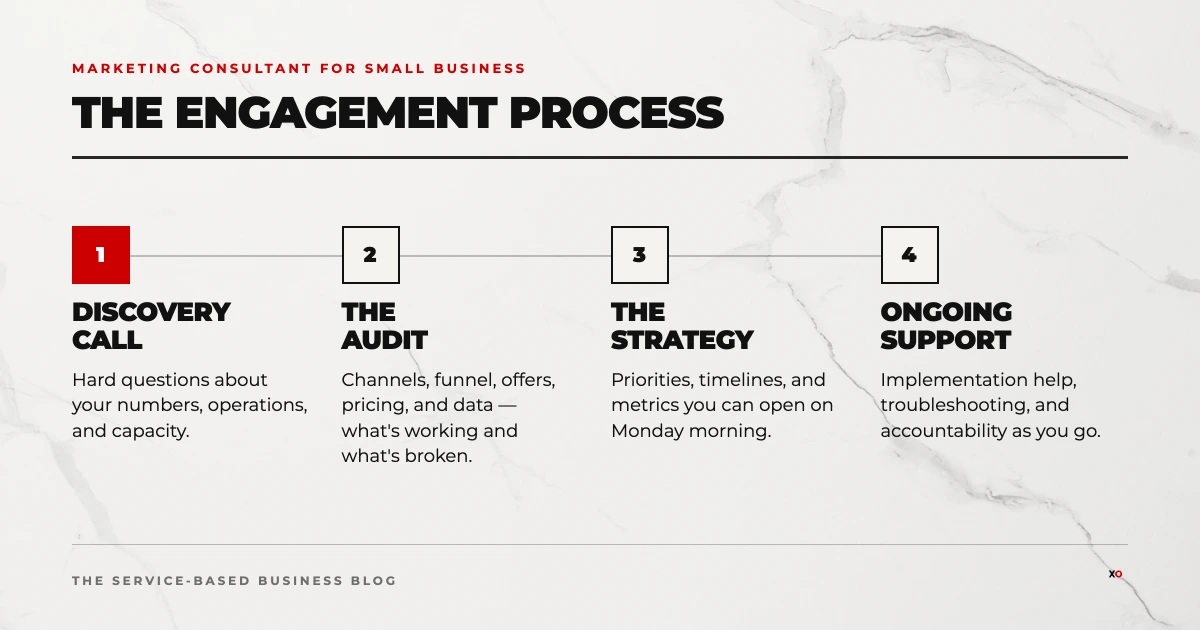
The Discovery Call
This is where you talk about your business, your goals, and what you're struggling with. A good consultant is going to ask you hard questions about your numbers, your operations, and your capacity. If they skip this step and go straight to pitching you a package, that's a red flag.
The Audit
Before any strategy gets built, the consultant needs to understand where you are right now. That means looking at your current marketing channels, your sales process, your offers, your pricing, your website, your content, and your data. The audit shows what's working, what's broken, and where the biggest opportunities are.
The Strategy
Based on the audit, the consultant builds you a marketing plan that's tailored to your business, your budget, and your bandwidth. You should walk away with a clear set of priorities, timelines, action items, and metrics to track. Something you can open on Monday morning and know exactly what to work on.
Ongoing Support
Some consultants deliver the strategy and send you on your way. Others stay on in a monthly capacity to help you implement, troubleshoot, and adjust as you go. If you're someone who needs accountability and real-time guidance, ongoing support is usually worth the investment.
How Much Does a Marketing Consultant Cost?
I know, I know. "It depends" is one of those answers we all hate to hear, but it's true. The cost depends on the consultant's experience, the scope of work, and how long the engagement lasts.
Here's what the market looks like:
| Engagement Type | Typical Cost Range |
|---|---|
| One-time strategy session | $500 – $3,000 |
| Audit + strategy package | $2,000 – $7,500 |
| Monthly retainer | $1,000 – $5,000/month |
| Full-time marketing manager (for comparison) | $80,000 – $160,000/year |
| Marketing agency (for comparison) | $6,000 – $10,000+/month |
The SBA recommends small businesses spend 7–8% of gross revenue on marketing. A consultant's fee is part of that budget, and it should be viewed as an investment in getting the rest of your marketing spend working harder.
To put that in perspective: if your business brings in $250K per year, your recommended marketing budget is $17,500 to $20,000 annually, or roughly $1,450 to $1,667 per month. If you're at $500K, that's $35,000 to $40,000 per year, or around $2,900 to $3,333 per month. A consultant's fee fits comfortably inside that budget and makes the rest of it work harder.
The real cost of NOT hiring a consultant is harder to calculate. It's the revenue you're leaving on the table because your marketing is inconsistent, your funnel has holes, or you're spending money on tactics that aren't connected to a strategy.
How to Choose the Right Marketing Consultant for Your Business
Not every consultant is the right fit for your business. Here's how I'd evaluate one if I were hiring.
Look at who they've worked with.
Have they worked with businesses like yours? A consultant who specializes in e-commerce is going to give you very different advice than one who specializes in service-based businesses. Industry experience matters because the strategies that work for a product business and a service business are fundamentally different.
Ask about their process.
A good consultant should be able to walk you through exactly what happens from the first call to the ongoing engagement. If they can't explain their process clearly, they probably don't have one.
Check for real results.
Not vanity metrics like followers or impressions. Real business results. Did their clients get more leads? Close more deals? Increase revenue? A consultant who can't point to specific outcomes probably isn't measuring them.
Pay attention to how they communicate.
During the discovery call, are they asking about YOUR business or are they talking about themselves the whole time? The best consultants lead with questions, not pitches.
Trust your gut on the fit.
You're going to be sharing real numbers, real challenges, and real vulnerabilities with this person. If you don't feel comfortable being honest with them, the engagement won't work no matter how good their strategy is.
What Results Should You Expect?
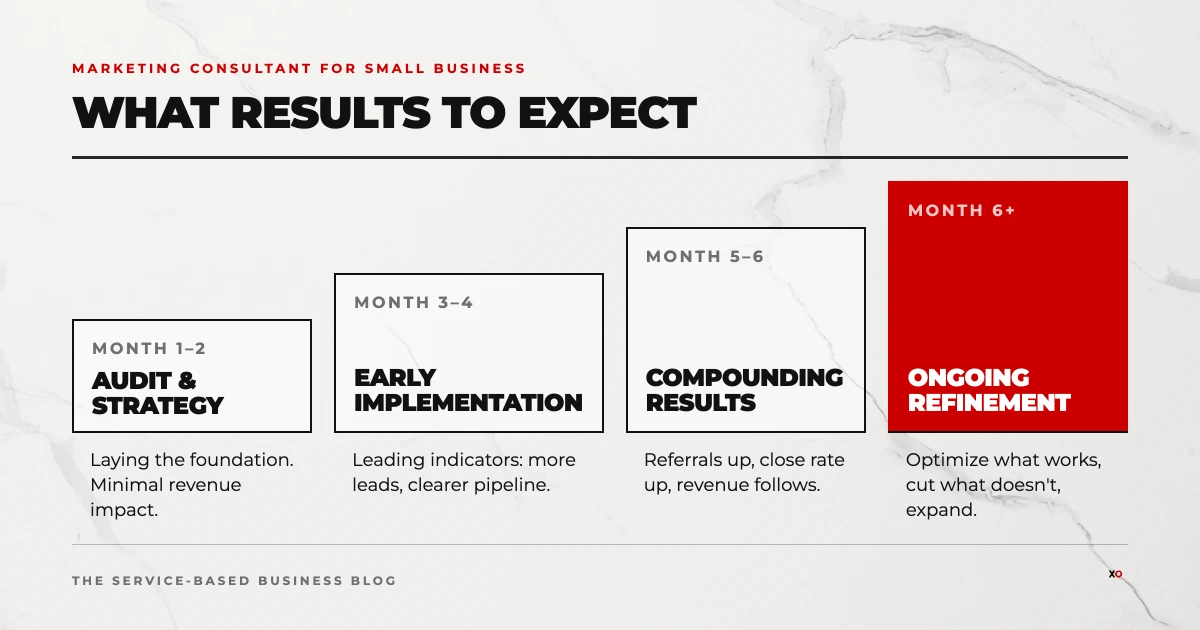
Marketing consulting isn't a magic switch. It takes time for strategy changes to show up in your revenue. Here's a realistic timeline based on what I've seen across 500+ engagements.
▶ Month 1–2: Audit and Strategy.
You're getting clarity on what to change, building the plan, and starting to implement. Revenue impact during this phase is minimal because you're laying the foundation.
▶ Month 3–4: Early Implementation.
New systems, new messaging, new priorities. You start seeing leading indicators like more leads, better conversations, and a clearer pipeline.
▶ Month 5–6: Compounding Results.
The marketing you put in place three months ago is generating results. Referrals increase because your positioning is clearer. Your close rate improves because your funnel is tighter.
▶ Month 6+: Ongoing Refinement.
You're optimizing what's working, cutting what isn't, and expanding into new channels or offers as the data tells you where to go.
If you're in that 37%, a consultant gives you back the time you're spending on figuring out marketing so you can focus on the work you're actually an expert at.
The Mistakes I See When Hiring a Marketing Consultant
Hiring based on price alone.
The cheapest consultant is rarely the best investment. You're paying for their experience, their thinking, and their ability to see patterns you can't see from inside your own business. A $500 strategy session from someone with two years of experience is going to give you very different results than one from someone with fifteen.
Expecting overnight results.
Marketing is a system. It takes time to build, test, and refine. If a consultant promises you immediate results, they're selling you a fantasy.
If a consultant promises you immediate results, they're selling you a fantasy.
Not being honest about your numbers.
If you downplay your challenges or inflate your success during the discovery process, the consultant builds a strategy based on inaccurate information. That strategy won't work because it wasn't built for the real situation.
Hiring a consultant when you need an executor.
If you already know exactly what to do and you just need someone to do the work, you need a freelancer or an agency, not a consultant. Consultants are strategic. Make sure you need strategy before you pay for it.
Ignoring the implementation.
The best marketing strategy in the world means nothing if it sits in a Google Doc and never gets executed. If you're hiring a consultant, make sure you have the capacity (or the support) to actually do what they recommend.
Conclusion
A marketing consultant for small business is the person who turns your inconsistent marketing into a system that produces predictable results. The right one brings experience, outside perspective, and accountability that's almost impossible to replicate on your own.
If you've been handling all the marketing yourself, if your revenue has been unpredictable, or if you know you need a strategy but can't seem to build one that sticks, that's the moment a consultant earns their fee.
The investment pays for itself when your marketing stops being something you do when things slow down and starts being the engine that keeps your pipeline full regardless of how busy you are with client work.
The investment pays for itself when your marketing stops being something you do when things slow down and starts being the engine that keeps your pipeline full.
If you're a service-based business owner looking for that kind of support, here's how I work with clients.